 Marie-Claire Asseko
The French version of this article is available ➡️ HERE ⬅️
The people who continue to use AI are not those with the best prompts. They are the ones who know how to organize their work.
Most of us do not have an AI problem. We have a housekeeping problem. And I say that as someone who helps people adopt AI for a living. 🤓
Why? Because the people who still use AI week after week, on a growing list of tasks, are rarely the ones with the cleverest prompts or the priciest subscription. They are the ones who can hand it four things:
- facts it can trust,
- documents it can find,
- the reasons behind past decisions, and
- a clear picture of how the work moves.
Those four things are also known as:
- data management,
- information management,
- knowledge management and
- process management.
Put them together, even at their most basic level, and AI becomes a habit and a powerful collaborator.
Skip them, and AI becomes the gym membership of the office: everyone has one that they seldom use.
This holds whether you are a solopreneur, a small-medium business or an enterprise-level organization with 5,000 employees. The scale changes. The principle does not.
Why Does AI Save Hours and Change Nothing?
Let’s start with a number that should bother us more than it does.
Glean’s Work AI Index 2026 surveyed 6,000 full-time digital workers in the United States, the United Kingdom and Australia. They say AI saves them about 11 hours a week. Yet only 13% say their organization performs significantly better because of it.
So where do the hours go?
The report has a word for it: botsitting. ➡️ Feeding AI the context it should already have, checking its answers, cleaning up after it. ➡️Workers spend 6.4 hours a week on that. More than half of what they say they save.
The pattern repeats at company scale:
- MIT’s Project NANDA: its July 2025 report, The GenAI Divide, found that 95% of the organizations it studied saw no measurable return on their generative AI pilots. The cause it names is tools that forget context, do not learn and do not fit the daily work.
- S&P Global Market Intelligence: 42% of companies abandoned most of their AI initiatives in 2025, up from 17% a year earlier.
I have read two articles that illustrate this phenomenon perfectly.
Sheriff Alimi, in Tech Safari’s Is Someone Taking Notes?, calls AI “a forgetting machine” because every session opens on a blank slate (unless configured otherwise). What it lacks is the third ingredient of any company’s productivity after people and skills: institutional knowledge.
- The decisions made in a chat thread.
- The reason a client gets a different price.
- The thing everybody knows and nobody wrote down.
Julie Averill, former chief information officer of Lululemon, wrote in The New York Times about AI pilots that dazzled in the demo and stalled in real life. The demo ran on clean, connected data. Her company’s data sat in systems that did not agree with each other, under years of exceptions and workarounds. Her conclusion:
The unglamorous cleanup of data, decisions and systems is where the real work is.
Julie Averill, former chief information officer of Lululemon
A newsletter for founders about African tech and an Opinion piece from a retail executive in North America. Two different realities, yet the same diagnosis.
The tool is fine. It’s the house that is a mess.
A Confession From the Demo Side of the Table
Averill’s story stung a little, because I know the other side of it.
In my professional experience as a pre-sales solutions architect, demonstrations, like the ones Ms. Averill mentions, are simply part of the job. By design, a demonstration takes place in a neat, orderly little world: clean data, clear steps, and a single, consistent version of everything. It always works. I mean… of course it works. Otherwise, I wouldn’t be giving the demo! 😅
Then, the client returns to their own real-world environment with my solution; only to find three spreadsheets that don’t align, a process that exists solely in a colleague’s head, and a shared directory that no one actually keeps up to date. I can guarantee you: that was usually the point where the real work with my client began.
That distance between the demo and Monday morning has nothing to do with how smart the tool is. It existed long before ChatGPT. AI just made it impossible to ignore, because AI needs everything the demo quietly assumed.
The Context Stack: Four Disciplines, One Foundation
What I came to call the Context Stack answers one question: what does AI need from you before it can be useful twice?
In my opinion, four layers are necessary and each one answers a question AI cannot answer on its own.
Yes, the all-powerful AI only has the answers it was trained on within its language model. It knows a great deal, but it lacks knowledge of things that are tacit or informal.
Oh, and I describe each layer in simple terms so that you can put the basics into place as early as this week.
1️⃣ Data Management: Can AI Trust Your Facts?
Data is the raw record: your numbers, your client list, your prices, your dates. Data management means there is one version of each, and it is right.
AI has no idea which of your three client lists is the current one. It will use the wrong one with total confidence.
- In an enterprise: a named owner for each key dataset, and a rule for which system wins when two disagree.
- In a SMB: one client sheet, one row per client, the same columns every time.
- As a solopreneur: one contact list, one calendar 📆, one place for your numbers.
2️⃣ Information Management: Can AI Find Your Documents?
Information is formatted or structured data: the proposal, the contract, the policy, the report. Information management means the right document can be found, is the latest version and is protected.
The enemy here has a great name in records management: ROT, for redundant, obsolete and trivial. Feed AI a drive full of ROT and it will quote your 2022 pricing back to you.
- In an enterprise: access rights, retention rules and a regular purge of ROT.
- In a SMB: one home per document type (proposals, contracts, invoices) and an archive folder for old versions.
- As a solopreneur: a folder structure you could explain to a stranger in one minute, and file names that say what and when.
3️⃣ Knowledge Management: Does AI Know Why?
Knowledge is what people learned by doing.
- Why we chose this supplier.
- How to handle that client.
- What failed last time.
Most of it is tacit, and the philosopher Michael Polanyi summed up the trouble in The Tacit Dimension: “we can know more than we can tell.”
AI cannot read what was never said.
Alimi retells a story Ben Horowitz shared about Facebook in 2008. Sign-ups stalled after hundreds of new engineers joined and bypassed a part of the system they did not know mattered.
➡️ The fix was not better engineers. It was a 40-hour course for every newcomer.
It was a knowledge problem, years before any chatbot.
- In an enterprise: lessons captured at the end of each project, and the reasoning recorded with the decision.
- In a SMB: a decision log. Date, decision, reason. One line each.
- As a solopreneur: a running “how I do it” note. After any task you would hate to redo from scratch, write five lines.
4️⃣ Process Management: Does AI Know How the Work Moves?
A process is the sequence: what triggers the work, who does what, in which order, and what “done” looks like.
Thomas Davenport and Thomas Redman argue in Harvard Business Review’s How to Marry Process Management and AI that process management is having a comeback because of AI, and that the first step is to give each process an owner. In plain words:
AI cannot improve work that nobody owns and nobody has described.
- In an enterprise: a named owner for each end-to-end process, and a measure of what good looks like.
- In a SMB: one client journey mapped from first message to paid invoice, with a mark wherever things wait.
- As a solopreneur: one recurring task, written as a numbered list of steps.
Why Do the Four Only Work Together?
Because each layer alone fails in its own special way.
- Clean data with no process gives you accurate answers to questions nobody asked.
- A mapped process on messy data gives you the wrong numbers, delivered faster.
- Tidy documents with no knowledge behind them give you an AI that follows the policy and misses the exception everyone on the team knows about.
Information scientists have drawn this as a pyramid for decades: data becomes information, information becomes knowledge. Process is how all three get put to work.
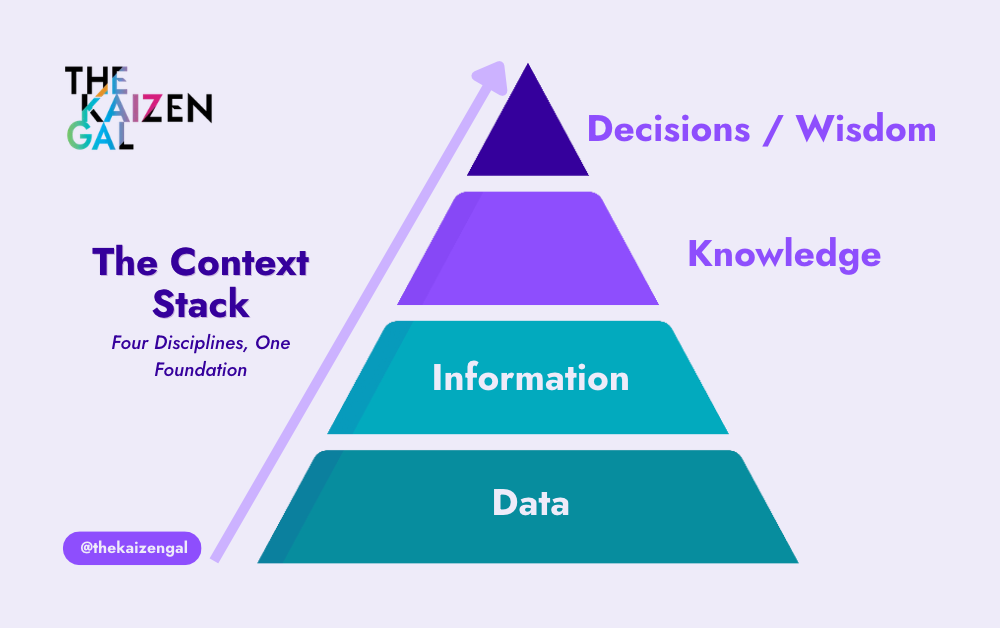
AI reads your whole stack at once. So it trips on your weakest layer.
Stop Automating Your Old Workflow
Here is where the housekeeping pays you back twice.
1️⃣ The first payback is the obvious one. Every task you have written down is a task you can hand over without explaining it from scratch. This week it is one. Next month, if you document consistently, it will be five. That is how AI use spreads across your work: slowly but surely, one documented task at a time.
2️⃣ The second payback is bigger. You cannot redesign what you cannot see.
McKinsey’s State of AI survey tested 25 organizational attributes against bottom-line impact from generative AI. Redesigning workflows had the biggest effect of all. Only 21% of organizations using generative AI said they had fundamentally redesigned even some of theirs.
Why so few? Because most of us ask the small question: which step of my current process can AI do faster? But once your stack is in place, you can ask the better one:
If this context is always available, which steps still need to exist in this workflow?
Alimi gives an example.
➡️ After a week away, the CEO of Lua, a Nairobi-based AI company, asked his AI workspace one question: what moved, what stalled, what needs me first?
➡️ He had his answer in minutes. Nobody wrote a report. What happened there: the weekly status report was not automated, it disappeared.
That is a new workflow. And nobody gets there by asking AI to write the old report faster.
Isn’t This Just Bureaucracy With a New Name?
Fair question. Process management earned its reputation. Binders nobody opens. Flowcharts that describe how work was supposed to go in 2019.
So, three guardrails:
- Document for use, never for the shelf: if a note has not been used by a person or by AI within a month, stop writing that kind of note.
- Update when the work changes: a process description is a living thing. Tie its review to a change in the work, not to a date in the calendar.
- Let AI take the notes: this is the irony I enjoy most. The tool that needs your notes is very good at drafting them. Record yourself explaining a task, ask AI to turn it into steps, then correct it. Ten minutes.
And let’s not kid ourselves: housekeeping does not fix everything.
If what you wrote down carries a bias, AI will repeat it at scale.
And people who fear for their job do not write down what they know.
➡️ The stack is the foundation. Trust is still the ground it sits on.
Closing Thoughts: Who Is Taking Notes in Your Place?
I find something reassuring in all of this.
The skills that make AI stick are neither new nor technical. Naming a file properly. Writing down why. Listing the steps. Assistants, coordinators, operations people and librarians have done this work for decades, usually without the title or the credit.
So if you have always been the one who “just keeps things organized”, you are not behind on AI. You are ahead. 💪🏾
Ambition is not the gap. Structure is.
Which leaves me with a question for you, and I do want your answer. You have four free hours this week.
➡️🎯 Do you spend them learning a new AI tool, or writing down how you do one thing you do every week?
Both can be defended but you only get to pick one.
TL;DR – Your AI Problem Is a Housekeeping Problem
- AI stalls for lack of context: workers say AI saves them 11 hours a week, and spend 6.4 hours a week re-explaining, checking and cleaning up. The model is not what is missing.
- The Context Stack fixes that: data management (facts AI can trust), information management (documents it can find), knowledge management (the why) and process management (how the work moves). Start each at its most basic level. They only work together.
- The prize is new workflows: once your work is visible, you stop asking which step AI can speed up and start asking which steps still need to exist.
In the following article, I share my own journey of adopting AI in my daily work, with examples illustrating how I’ve applied principles of data, information, knowledge, and process management. Check it out here: Building Your AI Organization – What building with AI taught me about rules and what I should never delegate.
Sources
- Glean Work AI Institute, The Work AI Index 2026
- MIT Project NANDA, The GenAI Divide: State of AI in Business 2025, as reported by Virtualization Review
- S&P Global Market Intelligence survey, as reported by CIO Dive
- McKinsey, The State of AI
- Thomas H. Davenport and Thomas C. Redman, How to Marry Process Management and AI, Harvard Business Review, January 2025
- Sheriff Alimi, Is Someone Taking Notes?, Tech Safari, August 12, 2026
- Julie Averill, I Helped Run Lululemon. The A.I. Revolution Is a Hot Mess., The New York Times, August 3, 2026
- Michael Polanyi, The Tacit Dimension, 1966