 Marie-Claire Asseko
Imagine a founder with three years of sales, repeat clients and a waiting list 📋.
She needs $150,000 to hire her first two employees and stop being the bottleneck of her own business. Except that:
- The micro-loan programs built for women like her stop well below that.
- The venture funds don’t look at a service business.
So she does what most of us do: she stays solo, works more hours, and calls it “running lean.”
That is not a personal failing. It’s a design flaw.
Introducing The Money Gap That Keeps Immigrant Women Founders Solo
In Canada, 86.4% of women entrepreneurs are self-employed rather than majority owners of an SME, against 74.9% of men (WEKH, The State of Women’s Entrepreneurship in Canada 2025).
For women from visible minority and immigrant backgrounds, the step from “I am the business” to “I own a business that employs people” is where the money runs out. Not the ambition. The money.
They’re too big for a micro-loan, yet too small for VC.
The Money Gap: What is the “Missing Middle”?
It’s the name I give to the founders who need roughly $50,000 to $250,000, sometimes up to $350,000, to hire, buy equipment or build inventory.
Let me be clear: this is my framing, not a Statistics Canada category. But look at where the capital sits:
- On one side, the programs designed for equity-deserving founders. The federal Women Entrepreneurship Loan Fund lends up to $50,000. Futurpreneur goes up to $75,000, if you’re under 40. Perfect to test an idea. Not enough to make payroll for a year.
- On the other side, venture capital. In 2024, information and communications technology companies took more than 57% of all Canadian VC dollars, according to the Canadian Venture Capital and Private Equity Association. A catering company, a consulting practice or a beauty brand is not what those funds were built for.
And the programs built for us are tiny. My own research estimates that funding intended for women, Black, Indigenous, immigrant and visible minority entrepreneurs added up to about $154 million a year between 2022 and 2024. That’s roughly 0.13% of the money flowing to Canadian SMEs. The other 99.87% moves through banks, private equity, venture capital and BDC.
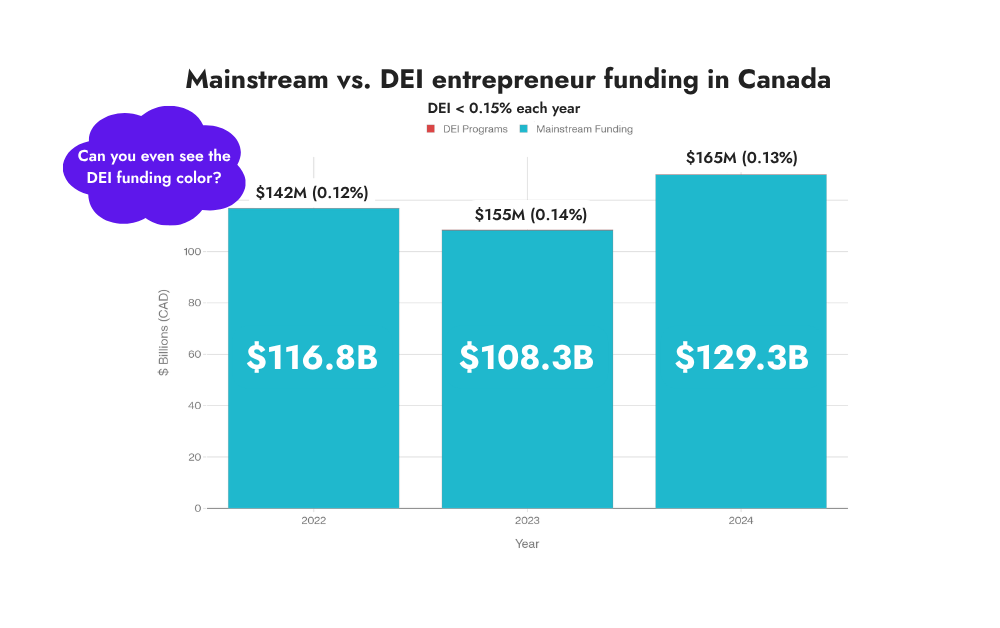
The real barrier is not the size of the diversity programs. It’s the door of the mainstream ones.
I’ve Stood in That Money Gap
I am Gabonese by birth and Canadian by adoption, a first-generation immigrant and a founder. In 2022, I started Xelirion, a software that connected drones to machine learning applications, whatever the drone maker’s brand. I placed third in a pitch competition. I went through an incubator, then an accelerator.

Then I hit the wall.
- I could not afford the hardware I needed for R&D, and I could not get a loan to afford it.
- The accelerator expected a full-time commitment, and I couldn’t afford to leave my job either. Talk about a loop! 😅
I ended up dissolving Xelirion in July 2023.
So when I read the data, I don’t read it as research. I read it as a receipt – evidence that what I experienced is not an isolated event.
The 6 Frictions Between a Solo Business and a Payroll
Why does the transition break? Because six frictions stack on top of each other. I call them the 6 frictions of the Missing Middle.
1- Why Does “No” Come More Often?
The Canadian Federation of Independent Business found that 22% of financing applications from women-only owned businesses were rejected outright, against 15% for all businesses (December 2023).
For Black founders, it gets worse. Toronto Metropolitan University’s Diversity Institute, in Pathways to Financing for Black Entrepreneurs (2026), cites a McKinsey analysis: Black-owned businesses in Canada are denied financing at 8x the rate. EIGHT.
Discrimination in lending results in higher rejection rates, higher interest rates, and stricter collateral requirements; even with good credit history.
- The WEKH report on Immigrant Entrepreneurship in Quebec found that during the pandemic, only 25.3% of immigrant entrepreneurs accessed subsidies, financing, or tax credits, compared to 44.4% of native-born entrepreneurs.
2- Why Does “Yes” Cost More?
Getting approved is not the end of the story. In 2023, majority women-owned SMEs paid an average of 13.7% on their lines of credit. Majority men-owned SMEs paid 10.4% (WEKH, 2025).
Same country. Same year. Three points more.
Why? Women founders feel a greater sense of responsibility towards their lenders. We’d sacrifice a lot rather than missing a payment or not honoring a commitment. I speak from my own experience, and that of others.
3- Why is Your Revenue “Unstable” and His isn’t?
Among majority women-owned SMEs that were turned down in 2023, 66.3% were refused for insufficient sales or cash flow. For majority men-owned SMEs: 30.1%. In 2017, that figure was 25.2% for women (WEKH, 2025).
WEKH’s reading: women bootstrap more, on savings and family loans, and lenders penalize them for it.
We get punished for the very thing the system pushed us to do.
4- What Do You Pledge When You Own Nothing Here?
Lenders assess what they call the 5 Cs of credit: character, capacity, capital, collateral and conditions.
In plain words: who you are, what you earn, what you own, what you can guarantee, and how the economy is doing.
Now imagine that you just arrived in Canada at 28 with no credit history, no family home and no inheritance. Three of the five Cs are gone before you open your mouth.
The numbers follow.
- In the 2021 Census, 45.2% of the Black population lived in a home owned by a member of the household, against 71.9% of the total population (Statistics Canada). No house 🏠, no home equity to borrow against. So founders pay out of pocket.
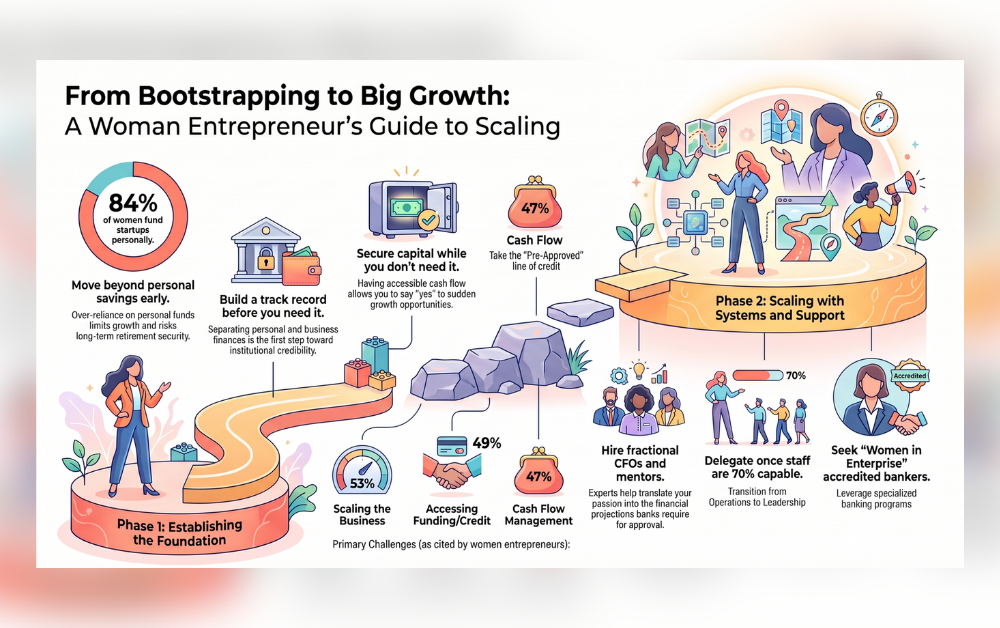
- In the largest Canadian study of Black women entrepreneurs, 81.4% used personal financing and only 17% used credit from a financial institution (Rise Up, 2021, 700 respondents).
- US research cited by the Diversity Institute gives a sense of scale: Black entrepreneurs start with $35,000 on average, white entrepreneurs with $107,000. That’s American data, and I haven’t found the Canadian equivalent. I doubt it would flatter us.
5- Why Bother Asking?
The Diversity Institute describes a “discouraged borrower syndrome”: Black entrepreneurs expect to be refused, so they do not even apply.
I asked 32 Montréal-based founders, all women from visible minority and immigrant backgrounds, in early 2026.
- Half of them would only take $100,000 if it came as an interest-free loan or a grant.
- 13% refuse debt categorically.
Is that fear? Partly. And it’s also arithmetic. ⬇️
If “no” comes more often and “yes” costs more, staying small is a rational decision.
It is understandable yes, but it is still a ceiling.
6- Who Has Time for the Paperwork?
In that same survey, 63% named the eligibility rules and application process of government grants and loans as their number one administrative burden. When you are the salesperson, the accountant and the delivery team, every hour spent on an application is an hour you don’t bill.
- The women entrepreneurship’s support ecosystem has become a “maze” of overlapping service providers and eligibility criteria.
- For immigrants who may already struggle with linguistic nuances or the complexity of the Canadian tax system, the administrative burden of applying for these overlapping programs is often prohibitive.
And for some, the door isn’t even there. HEC Montréal’s 2021 report on immigrant entrepreneurship in Quebec found that 28% of immigrants intend to start a business, against 14.7% of people born here. The same report asks Quebec to rethink the status of entrepreneurs who are not yet permanent residents so they can access support measures. Twice the intent. Not the same door.
But the Loans Exist, Don’t They?
Yes. And I’d be dishonest if I skipped this part.
- BDC’s Inclusive Entrepreneurship Loan goes up to $350,000 for businesses majority owned by women, Indigenous or Black entrepreneurs.
- The Black Entrepreneurship Loan Fund lends up to $250,000.
- And the approval gap between women and men looks narrow on paper: 88.6% against 91.4% in 2023 (WEKH, 2025).
So where’s the problem? Well, it’s before the application – in the funding readiness.
Indeed, a loan of that size usually calls for current financial statements, a plan for the capital and a credit history. Meanwhile half the founders I surveyed had no up-to-date statements, and nobody taught them they’d need them. Nobody explained how lenders look at a business in order to decide if backing it financially is worth the risk.
A visible product on a shelf you can’t reach is still not accessible.
What Would Close the Money Gap?
Not another micro-loan. Here are three things I suggest, from the hardest to the easiest:
- Lenders willing to read cash flow, not just collateral: A founder with three years of invoices has proven something a house never will.
- Support that prepares founders for capital, not only for launch: Most programs teach you to write a business plan. Few teach you to build the file a lender needs to see.
- Your own numbers, up to date: If you are that founder, close your books for last quarter this month. It costs nothing, and it’s the first thing anyone with money will ask you for.
What Are We Leaving on the Table?
I think about Xelirion less than I used to. But I think often about the women I meet who are exactly where I was: a business that works, clients who pay, and a ceiling the height of their own two hands 👩🏾💼.
They don’t need to be convinced to dream bigger. They need the $150,000, and a system that knows how to hand it to them.
So here’s my question.
➡️ If you fund, lend to or advise entrepreneurs: who is the last founder you sent away because she was too big for one program and too small for the other? And where did she go?
TL;DR – The Money Gap, or Why Women Founders Struggle to Scale
- Immigrant and visible minority women founders who need roughly $50,000 to $250,000 to hire or scale fall between micro-loans and venture capital. I call it the Missing Middle.
- Six frictions stack up: more refusals, pricier credit, revenue judged “unstable,” nothing to pledge, founders who stop asking, and paperwork or status rules that shut the door.
- Larger loans exist. What’s missing is what comes before the application: current financials, a capital plan, and lenders who read cash flow instead of collateral.