 Marie-Claire Asseko
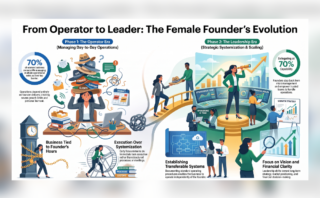
This is the 6th article in a series on what holds back women founders from visible minority and immigrant backgrounds. The others: (1) What Stalls the Growth of Women Founders? | (2) 4 Frictions to the Growth of Women Founders | (3) The Math is not Mathing for Women Founders in Canada | (4) The Money Gap, or Why Women Founders Struggle to Scale | (5) From Operator to Leader: The Woman Founder’s Evolution 🤓
“Women founders ask for less.”
You’ve probably heard that sentence on every panel about women and money. And there’s proof to back it up: in Canada, in 2023, majority women-owned SMEs requested $185,676 in financing on average, against $495,941 for majority men-owned SMEs, according to the Women Entrepreneurship Knowledge Hub’s State of Women’s Entrepreneurship in Canada 2025.
But I think this sentence is incomplete: less than what? 🤔
- Less than a lender would approve?
- Less than a man would request?
- Or less than your business needs to scale?
I could not find a Canadian dataset that reports what women founders from visible minority and immigrant backgrounds ask for, let alone how it compares to what their businesses need to scale. So this article works with what exists: the national numbers, the survey I ran in Montréal in early 2026, and what founders from our communities have said on the record.
What Is an Approval-Sized Ask?
An approval-sized ask is a number built backwards from the funder: it’s what feels defensible, what a program caps at, what you believe someone like you will be approved.
Simply put, that’s the number women founders ask because they’re scared of rejection.
A business-sized ask is built forwards from the business: what the opportunity requires, the operating model and the scale you are aiming.
That’s the number women founders need to scale their business’ operations to the vision they have in mind.
Same founder. Same business. Two very different numbers.
Is the smaller one at least safer? No. The same WEKH report shows that women-owned SMEs received 92.2% of what they requested, against 87.7% for men-owned SMEs.
➡️ A high yes-rate on a small number looks like success, and that is the trap.
➡️ An approved financial ask can still be the wrong ask.
I know because I made that mistake myself, as a first-generation immigrant founder, despite being very familiar with the gaps in the financial ecosystem support for women founders from visible minority and immigrant backgrounds. 🫠 So I am not lecturing you, I am sharing what I, myself, need to know.
Why Do Women Founders Shrink their Ask Before Anyone Says No?
What’s the problem? Confidence? Scarcity? Financial unstability?
Through research and discussions, I have noticed that women founders tend to discount the real number that they want at least 3 times before even having a conversation with anyone.
1- The Credibility Discount: “Will They Believe Me if I Ask For This Number?”
Caroline Somba, founder and fractional CFO of Topspin Finance, describes herself as a Black woman and an immigrant. In an interview with CanadianSME (February 2026), she recalls rooms where she was not immediately perceived as the decision-maker, and names the pressure Black entrepreneurs feel to stay within what seems acceptable or proven. Her warning: “don’t confuse playing it safe with playing small.”
This pressure is not a figment of her imagination. In the WEKH and TD survey of women entrepreneurs (June to September 2025, a mixed sample in which 35% were Black or racialized and 24% immigrants):
- 45% reported gender-related bias in how their credibility was assessed;
- 31% reported being directed toward smaller loan amounts.
That survey does not break its answers down by race or immigration status, so read it as a floor for us, not a measurement.
Get denied once, and next time you’ll shrink the number “naturally”.
2- The Safety Discount: “What if I Cannot Pay It Back?”
The founders I surveyed lean hard toward money that costs nothing: a grant or an interest-free loan first and, for a few of them, no debt at all.
It’s understandable: when you have rebuilt a life from zero in a new country, with no family home 🏠 to pledge and relatives counting on you, debt is not a neutral tool. That caution is rational.
It also caps the ask at whatever is free, or low-risk / low-yield.
3- The DEI Discount: “What’s Offered to Founders Like Me?”
Look at what’s available: the federal loan fund built for women entrepreneurs stops at $50,000.
➡️ When the program designed for people like you stops at $50,000, what does your ask become? $50,000. Your vision and your plan get re-written to fit the application form📋.
Somba sees the same reflex in pricing: founders who price out of fear of rejection end up with margins too thin to reinvest. Same discount, different invoice.
None of this is a lack of ambition.
The 4 Sizes of an Ask: What Are You Buying?
The wrong question is “How much money can I get?”
The useful one is:
What stage am I in, what must be true before the next one, and what does that cost?
A business-sized ask comes in four sizes:
- Validation-sized, to buy proof: enough to create demande and show that customers will pay.
- Stability-sized, to buy predictability: operations and cash flow you can forecast from one month to the next.
- Scale-sized, to buy capacity ahead of demand: people, systems, distribution, inventory or a new market, paid for before the revenue shows up.
- Shock-sized, to buy room for a bad quarter: slow-paying clients, seasonality, one wrong assumption.
Most of us can price a launch: equipment, inventory, a website, registration, a first marketing campaign.
But opening a business and building one are two different budgets. Building a business requires several elements:
- Working capital
- Customer acquisition over several cycles, not one campaign
- Inventory and supplier terms
- Technology and systems
- Legal, bookkeeping and finance capacity
- A first employee or specialist
- Time to test, adjust and recover from wrong assumptions
- A founder salary, or personal runway
When a woman founder shrinks her financial ask, she deletes one of these to appear reasonable in her ask. Which line did you?
This is where the mismatch bites.
Put a validation-sized ask on a business that needs scale-sized capital, and the new sales land on a founder who is already the bottleneck.
So, when did being “reasonable” become this expensive?
Is a Cheque Even the Right Shape?
Okay. You’ve stopped trying to look reasonable. You did the maths and you have YOUR number; the money your business needs to make your vision a reality. Two checks comes to my mind before your number goes out:
The financing instrument
A grant does not dilute your ownership and usually does not get repaid. I get the appeal. But every instrument charges something beyond interest or dilution: restrictions, reporting, timing, collateral, your attention. Can you build your plan around whichever grant is open this quarter? You can. It just becomes the grant’s plan, not yours.
Debt deserves the same cold look, without ideology or prejudice. “Women avoid debt” is too blunt to be useful. I see four positions:
- Refusing debt.
- Being cautious about debt.
- Being ready to take on (more) debt, maybe even having appetite for it.
- Being restricted by the type of debt you can take on.
I have stood in the last one: a loan I could not get contributed to me closing my first company. So the question is not “is debt dangerous?” It is:
Does this debt pay for something that brings in more than it costs, without eating away at my cash flow?”
The non-financial ask
Sometimes the business-sized ask is not money at all. It is a major customer, a sponsor inside an institution, a technical operator, better supplier terms, an introduction, or someone who will challenge your assumptions.
When your network does not naturally include investors or procurement decision-makers, that ask can be worth more than the cheque.
Somba’s answer to closed networks was to build her own credibility instead of waiting for an invitation. Waiting is not a funding strategy either.
And What Does the Person Across the Table Need to See?
Let’s reverse the lens. You are the lender, the investor or the buyer. What tells you that a larger ask is a credible investment and not wishful thinking?
- A realistic downside case: what happens to repayment or delivery if the plan runs late.
- Margins and unit economics: what one sale costs you and what it leaves.
- Cash conversion cycle: how long between paying your suppliers and being paid by your clients.
- Customer concentration: how much of your revenue walks out the door if one client leaves.
- Evidence of demand: repeat purchases, contracted revenue, a waiting list.
- A team plan: who does the work once it stops being you.
- Milestones and use of funds: what each dollar buys and what it unlocks next.
- Current financial statements 📊: the first thing you will be asked for, and the easiest item on this list to produce.
Confidence does not come from sounding certain. It comes from showing that you understand what must be true for the plan to work, and what you will do if it does not.
A bigger number that is not backed by anything is not bold; it’s a wish.
Is Every “No” Proof That You Are Not Ready?
For women founders from visible minority and immigrant backgrounds, the financial conversation is rarely only financial. It carries a migration history, family obligations, Canadian institutions we did not grow up with, language, racism and gendered expectations.
WEKH’s State of Women’s Entrepreneurship in Canada 2024 reports that 53.5% of Black women entrepreneurs immigrated to Canada, and lists language, unrecognized foreign credentials and complex registration, licensing and tax rules among the hurdles immigrant women face. In the WEKH and TD survey, 33% of women reported having been denied loans without clear explanation.
This could be interpreted 2 ways.
- The first: every rejection proves I am not ready.
- The second: every barrier proves the system cannot be navigated.
They sound opposite but they end in the same place for us: we’ll ask for a smaller amount next time we have the opportunity.
So sort each “no” before you absorb it: Was it the application you prepared, the instrument you chose or the door you wanted to go through?
- The application: you fix it.
- The instrument: you change it.
- The door: you find another one, and you bring someone who can open it.
And for the funders reading this: a financing ecosystem that stops at loans of $50,000 will keep producing $50,000-sized asks, business models and entrepreneurs. That one is not on us.
What I Would Ask Myself Now
When I look back at my own situation, the number I came to was not the mistake: I started from the yes and worked backwards to a figure I could defend. Now I start from the business, then work out who can fund which piece, with what instrument, and what has to be true first. 💪🏾
That process is slower yes, but it yields a number I won’t regret in two years.
So take the last number you put in front of someone: a grant, a loan, a contract, even a price.
Whose comfort was it sized for: the gatekeeper’s, or the business’s?
TL;DR – How Much Should Women Founders Ask For?
- “Women ask for less” is the wrong diagnosis. The useful one: an approval-sized ask is built backwards from what a gatekeeper will accept, and a business-sized ask is built forwards from what the business requires.
- For women founders from visible minority and immigrant backgrounds, three discounts shrink the number before asking anyone anything: credibility, safety and DEI offering.
- Size the ask to the stage (validation, stability, scale, shock), check the instrument and the non-financial ask, then back it with a solid application, starting with current financial statements.
This is the 6th article in a series on what holds back women founders from visible minority and immigrant backgrounds. The others: (1) What Stalls the Growth of Women Founders? | (2) 4 Frictions to the Growth of Women Founders | (3) The Math is not Mathing for Women Founders in Canada | (4) The Money Gap, or Why Women Founders Struggle to Scale | (5) From Operator to Leader: The Woman Founder’s Evolution 🤓