 Marie-Claire Asseko
When does scaling a business shift from managing operations to leading it?
Imagine your revenue triples next quarter. Same offer, same quality bar, three times the volume. What breaks first?
I put that question to 32 self-employed women from visible minority and immigrant backgrounds in Montréal in early 2026: 75% of them gave the same answer. ⬇️
Me. My own delivery capacity, my own client relationships.
Only 13% said nothing would break.
That answer settles the question. The shift from managing operations to leading a business does not arrive with a revenue number or a headcount. It arrives the day our capacity stops being the engine and becomes the ceiling.
Why is This a Conversion Problem And Not a Workload Problem?
At the start, hands-on execution is the strategy. We sell, we deliver, we invoice, we fix what broke on a Friday night. It works, and that is exactly the trap: cash flow stays tied to our personal hours. So when demand rises, we add hours. Then more hours.
I call the way out the conversion moment: the passage from being the business to building one that can operate, borrow and employ beyond you. You know when they say “working ON the business as opposed to working IN the business”.
It is a completely DIFFERENT job.
- Managing operations means adding production ourselves.
- Leading means building the repeatable processes, the delegation structure and the decision rules that let production happen without us in the room.
Most women in business in Canada stand close to that conversion moment:
- The Women Entrepreneurship Knowledge Hub’s State of Women’s Entrepreneurship in Canada 2025 reports that in 2023, 86.4% of women entrepreneurs were self-employed rather than majority owners of an SME, against 74.9% of men.
- The same report shows what the far side is worth: majority women-owned SMEs generate over $90 billion in annual revenues and employ close to one million people.
Same talent on both sides. Different structure.
I Know What Straddling That Moment Costs
In 2022, I founded Xelirion, a software that connected drones to machine learning models, whatever the drone maker’s brand. I placed third in a pitch competition, went through an incubator, then got into an accelerator cohort.
Long story short: the cohort required a full-time commitment and I could not afford to leave my job, neither could I get a loan for the R&D equipment. After months of struggling to move the technical roadmap forward, I dissolved Xelirion in July 2023.
Oh boy, did I learn more than I had planned to splitting my hours between working in the business, working to put food on the table, attending the accelerator’s sessions…I was stretched EXTREMELY thin. Too thin to work on the business.
But I’ll forever remember: a business that only moves when its founder has hours left over is not short on ambition, it is short on structure.
Yes, I lacked the money to move forward BUT my time and priorities management skills evolved to a whole new level!
The 4 Conversion Signals: How do You Know the Conversion Moment Has Come?
Across the founder conversations I have had and research I have done, I’d say that this conversion moment shows up in four ways. And we should act on as soon as one shows up.
Signal 1 – Your Attention to Details Slows the Machine Down
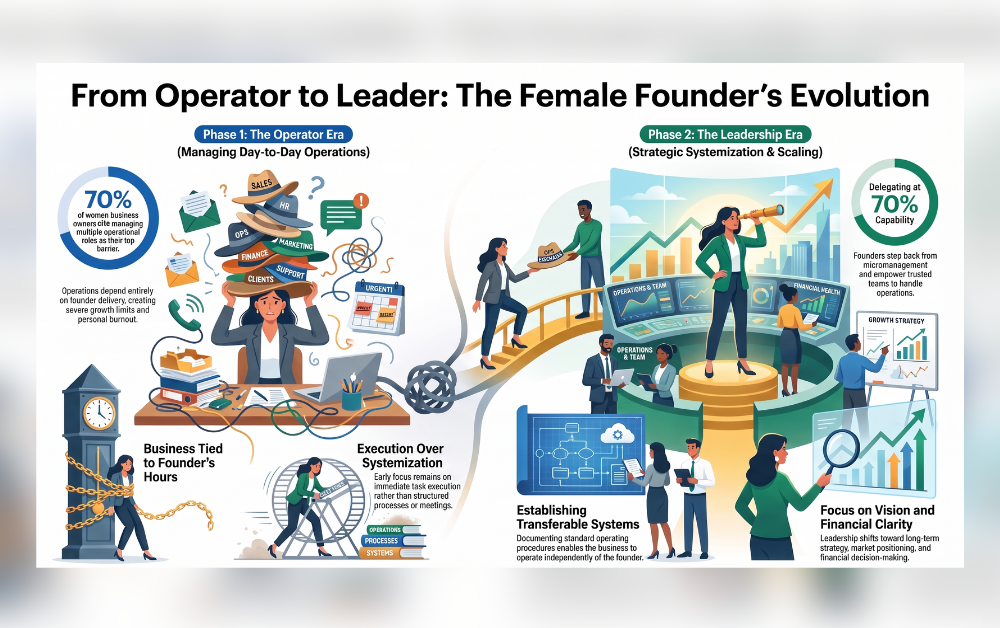
Early on, checking everything protects quality. Later, every decision waiting on your approval is a queue, and you are the only counter open. One threshold that came up in those conversations: hand a task over once someone can do it about 70% as well as you, then step out of the way.
Waiting for 100% is just control with better branding.
Signal 2 – Your Cash Flow Depends on Your Personal Hours
If you stop for two weeks, does revenue stop too? Then the business is still a job.
This is where written processes, standard operating procedures and a first hire stop being administrative work and become a value-add for your business.
A detail from my survey that should worry us: 88% of respondents named increasing sales as their top challenge, yet 50% had no regularly updated financial statements. You cannot delegate, or borrow against, what is not written down. 📊
Signal 3 – Demand Grows Faster Than You Can Absorb it
Doubling your volume in a single year sounds like the dream. But staying in operational mode through rapid or intense growth comes with the risk of burning yourself out. As well as the other people helping you carry the load.
This is the point to step back into planning: setting up a fixed meeting rhythm, re-training your team to handle the growth, creating a contingency plan for every critical role – including yours.
Signal 4 – The Machine Runs, and Nobody is Looking Ahead
The quietest signal. Operations are predictable, cash comes in on schedule, and your days still fill up with troubleshooting out of habit.
But once the machine is well-oiled ⚙️, your job as a leader is actually to step back: read the finances, check decisions against the company’s values, pick the next avenue for expansion.
Nobody else is paid to do that. Nor should they be at this stage.
The vision is yours to continue envisioning.
So What Does Leading Consist of, Concretely?
Verne Harnish’s Scaling Up framework reduces leading to four decisions. Put plainly, they are the four things only you can own once you stop owning the delivery:
- Cash: A financial strategy, built with advisors or a banking partner, instead of a bank balance checked on Sunday night.
- Execution: Disciplined meeting cadence and systems someone else can duplicate.
- Strategy: Direction set from core values and long-term goals, not from this week’s inbox.
- People: The right person in the right role, with training and room to reach their potential. The business scales at the speed they do.
Notice what is missing from that list: doing the work. Because your main role is not that of an operator anymore, but of a LEADER.
And if four decisions feel like a lot, start with the smallest step. Write down one process you repeat every week 📝, exactly as you do it. That page is the first thing you will ever hand over.
And What if the Structure Around You Makes Stepping Back Harder?
I get it. Let’s not pretend this is only a matter of willpower.
Stepping back costs money before it returns any, and you need someone to hand things to and someone to think with: scarcity and isolation are real challenges for entrepreneurs. My survey confirm that both are scarce.
- 50% of respondents would only take $100,000 if it came as an interest-free loan or a non-repayable grant, and 13% refuse debt categorically.
- 63% turn first to peers, family or community circles for high-level business advice; only 13% have a board or an institutional advisor. And 38% have never shared a critical business decision with anyone.
Read that last number again. That is a lot of founders carrying every call alone.
For women founders from visible minority and immigrant backgrounds, the conversion moment is rarely blocked by skill. It is blocked by the infrastructure around it: capital required to take the next step forward, advisors who understand the business model, peers who have already crossed that conversion moment.
One caveat, because it matters: staying solo is a legitimate choice.
What I am arguing against is staying solo by default because nobody showed you the door upward existed.
Hindsight is 20/20
When I look back at Xelirion, I do not see a founder who lacked drive. I see one who had no structure to step back into, and no room to build it. I suspect many of my survey respondents would say the same. 💪🏾
So here is the question I would rather you answer now than when your revenue triples:
If you were unreachable for a month, what is the first thing in your business that would stop – and who are you currently preparing to own it?
TL;DR – From Operator to Leader: The Women Founder’s Evolution
- The shift from managing operations to leading happens when your personal involvement stops adding value and starts capping the business; not at a set revenue or team size.
- The 4 Conversion Signals: your control slows execution, your cash flow depends on your hours, demand outgrows your people, or the machine runs with nobody looking ahead.
- Leading means owning four decisions (Cash, Execution, Strategy, People) instead of the delivery; and it takes capital, advisors and peers around the founder, not just willpower.