
 Marie-Claire Asseko
This is a longer piece for a LinkedIn post I wrote in French after reading an article (in French only) about workplace injustice published by Revue Gestion HEC Montréal, and being reminded of how it influenced my own experience with misalignment burnout.
Workplace injustice and misalignment burnout are distinct concepts, but they often overlap to the point of reinforcing one another.
The Fundamental Link Between Workplace Injustice and Misalignment Burnout
- Workplace injustice refers to the perception that the organization, its decisions, or its members do not treat people fairly. It affects engagement, stress, and a sense of self-worth, and can lead to emotional exhaustion.
- Misalignment burnout occurs when a person must continually act in ways that conflict with their values, core beliefs, or professional identity. This prolonged dissonance creates psychological wear-and-tear that can lead to exhaustion.
In other words:
- Injustice answers the question: “Am I being treated fairly?” ”
- Misalignment burnout answers the question: “Can I remain true to what is important to me in this context?”
How Workplace Injustice Fuels Misalignment Burnout
1. Workplace Injustice Often Violates Employees’ Fundamental Values
A person who values fairness, merit, transparency, or integrity will suffer more in an environment where:
- Promotions seem arbitrary—or worse, completely relationship-based (who knows who, who’s sponsored/mentored by who, etc.);
- Certain employees are favored—even as some of them might not be putting as much work as others;
- Rules vary depending on the person;
- Decisions are not explained but rather imposed with the somewhat gaslighting ask (i.e. both aspirational yet unequivocal) for employees to be “agile”, “flexible” and “collaborative—dismissing or devaluing in the same breath any opinion or feeling that is contrary to the ask.
Workplace injustice is therefore not just an organizational problem:
It becomes a conflict between the workplace and the employee’s personal values.
2. Employees begin to self-censor in order to survive
When the behaviors valued by the organization are incompatible with personal convictions, the employee may:
- remain silent even when they would like to speak up about a problem;
- accept decisions they consider questionable;
- pretend to go along with practices they do not believe in.
This dissociation between the “professional self” and the “real self” is a central element of misalignment burnout.
Just writing this makes me wince…because the wear-and-tear and the weight of that psychological dissonance are pervasive yet subtle enough that we actually can NOT realize it’s happening.
3. A Sense of Meaning is Lost
The article in Revue Gestion indicates that an employee who perceives injustice may lose a sense of meaning in their work and gradually become disengaged. I’d even add that with meaning disappearing, so does belonging.
Misalignment burnout produces a similar effect:
- decreased motivation;
- feelings of uselessness;
- cognitive fatigue;
- loss of energy.
The psychological mechanisms converge.
4. The Most Engaged Employees May Be the Most Vulnerable
Employees who are highly conscientious, high-performing, or strongly value-driven often try to compensate for organizational dysfunctions.
My experience illustrates this dynamic precisely: attempting to fill the gaps in the system until exhaustion sets in.
➡️ I did not burn out solely because of my workload. I burned out because I was constantly trying to reconcile my values with a reality that contradicted them.
When Does Workplace Injustice Become Dangerous?
Not all instances of injustice lead to misalignment burnout. But the risk increases when the following three conditions are present:
- The injustice is repeated.
- The employee has no control over the situation.
- The injustice directly conflicts with their non-negotiable values.
From my experience, it is the continuous combination of these three factors that transforms occasional frustration into a chronic identity conflict.
How to Protect Yourself
Identify Your Non-Negotiables
Explicitly define:
- your core values;
- unacceptable behaviors according to your values, beliefs and professional aspirations;
- minimum conditions for maintaining your psychological well-being.
I cannot emphasize enough the importance of identifying and upholding one’s core values!
Distinguish Between Remediable and Structural Issues
Some situations can be corrected:
- lack of information;
- poor communication;
- poorly explained processes.
Other situations are structural:
- chronic favoritism;
- persistent lack of transparency;
- a culture incompatible with personal values.
The Revue Gestion’s article highlights that many perceptions of injustice can be reduced through transparency, clarification of criteria, and better communication.
Watch for Early Warning Signs
Common signs observed in both cases:
- growing cynicism;
- social withdrawal;
- decreased motivation;
- disproportionate fatigue;
- difficulty concentrating;
- irritability;
- loss of meaning.
These symptoms often appear before full-blown burnout. ⚠️
Avoid the Role of “System Fixer”
A common mistake is to believe that an employee, even a high-performing one, can sustainably (i.e. in the long-term) compensate for the flaws in a culture or structure.
➡️ When a person continually devotes their energy to correcting problems that the organization is unwilling to address itself, the risk of burnout due to misalignment increases significantly.
Keep an Exit Strategy Open
Having a real possibility of changing teams, roles, or employers reduces feelings of helplessness: prolonged powerlessness is one of the factors that transform a difficult situation into lasting psychological distress.
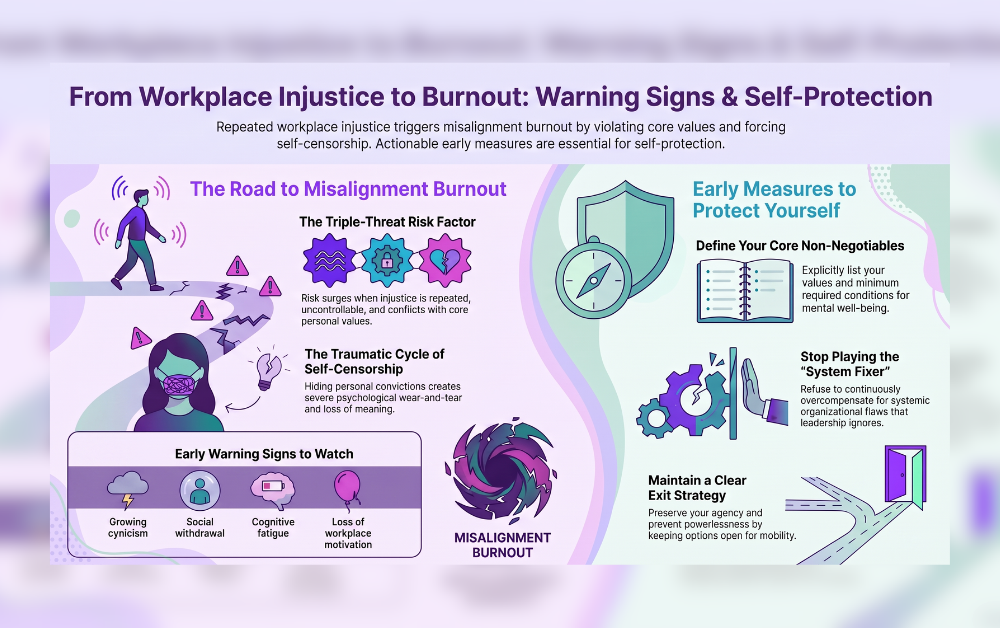
TL;DR – How Workplace Injustice Can Cause Burnout
Workplace injustice and misalignment burnout are linked by a common mechanism: the conflict between what a person considers fair and what their environment requires them to accept.
Injustice causes harm. Misalignment burnout occurs when this harm becomes chronic and forces the employee to act against their values, identity, or conception of work over a long period of time.
Have you experienced either one or both? What have you done to get yourself out of the situation?