 Marie-Claire Asseko
This is the 7th article in a series on what holds back women founders from visible minority and immigrant backgrounds. The others: (1) What Stalls the Growth of Women Founders?| (2) 4 Frictions to the Growth of Women Founders| (3) The Math is not Mathing for Women Founders in Canada| (4)The Money Gap, or Why Women Founders Struggle to Scale| (5) From Operator to Leader: The Woman Founder’s Evolution | (6) How Much Should Women Founders Ask For? 🤓
Founders should know their numbers.
Your banker, your accountant and every other panelist at an entrepreneurship event will tell you that. Although that’s definitely try, as a budding entrepreneure, that sentence also bugs me. Truly.
Because it never says which numbers!
So we learn one. Usually revenue, sometimes break-even. We hold on to it, and we walk into the room with a single figure and we think we are fine.
Here is the catch: the right number can tell the wrong story. Yes, you’ve heard me right!
So: what numbers should a woman founder should know?
What Numbers Tell the Truth?
Sales have one: what is left after you deliver. Break-even has one: how long your clients take to pay. Capacity has one: how much cash goes out before the order pays you back.
The first number describes. Th other 2 numbers show a gap. And understanding that gap is what we should focus on.
For instance, in early 2026, I surveyed 32 women founders from visible minority and immigrant backgrounds in Montréal. 88% named growing sales as their top challenge. Half had no up-to-date financial statements.
So the number we watch is sales, and the number that says whether those sales leave anything behind is out of date.
- Among majority women-owned SMEs turned down for financing in 2023, 66.3% were denied for insufficient sales or cash flow, against 30.1% for majority men-owned SMEs, according to the Women Entrepreneurship Knowledge Hub’s State of Women’s Entrepreneurship in Canada 2025.
Is it a knowledge problem? Not at all. Nobody doubts that you know your sector. It is a pairing problem. As Caroline Somba, founder and fractional CFO of Topspin Finance, puts it in her interview with CanadianSME (February 2026): “[Black founders should adopt] a cash flow lens early, not just a revenue focus”. Many founders have the sales, she says, without seeing the timing, the margins or what selling more does to their cash flow.
I Knew My Break-Even Number. I Missed The Others.
I was born in Gabon, I am Canadian by adoption, and I am a first-generation immigrant founder. After months of researching what keeps women founders from scaling, I put together a financial ask for my own project and sized it to break even on a timeline I could easily defend, as I admitted in 4 Frictions to the Growth of Women Founders.
I knew that number cold.
What I had not put next to it was the runway it takes to build a product people cannot do without. A more experienced founder who advises me caught it. I did not…despite the research open on my desk 🫠.
So I asked for money to break even. The business needed runway.
Again: same founder, same spreadsheet, wrong ask.
The Second Number: 4 Questions to Ask Yourself
Eight pairs sounds like a finance course. It is four questions, and you probably already ask yourself these questions. In each pair, the first number is the one we tend to quote. The second is the one that changes the ask.
1- Is the Demand Committed, or Only Loyalty-Based?
- Repeat purchases vs. contracted revenue: a client who comes back chose you again. She did not promise a next order. Contracted revenue is money someone has agreed to pay, subject to the terms of an agreement.
Track both, because a lender or a buyer hears them differently. One is loyalty and means recurring revenue. The other is commitment and can change long-term planning.
The ask changes from “I need more customers” to “I need a 12-month agreement with the clients who already reorder.”
2- Does a Sale Leave Anything Behind?
Or, how much does it cost you to deliver a product or service vs. how much do you sell it for? 🧮
- Gross margin vs. EBITDA: gross margin is what remains after the direct cost of delivering what you sell. EBITDA (earnings before interest, taxes, depreciation and amortization) is what remains once rent, admin, software and marketing are paid too. A strong margin with a thin EBITDA means your overhead is eating the sale.
- Clear margins vs. unit economics: a margin is only clear once you’ve defined which costs are in it. Unit economics runs the same math on one unit, one order, one client or one contract. A healthy average can hide an offer that loses money every time it sells.
- Customer acquisition cost (CAC) vs. customer lifetime value (CLV): what you spend to win a client, against what she leaves you over the whole relationship. Stripe’s guide to customer lifetime value treats an acquisition cost lower than lifetime value as a key sign of profitability. Compare the cost with the gross profit an engagement leaves, not with what it pays.
A made-up example: you spend $400 to win a client that brings in $300 in gross profit. This means you are actually losing money on the initial acquisition with a net loss per new client of $100. This net loss increases with every new client.
➡️ To make this profitable, you either need to reduce your CAC, increase the price/margin of your service, or ensure the client stays long enough to buy from you multiple times (increasing their CLV).
Somba sees it in pricing: founders who price out of fear of rejection end up with margins too thin to reinvest or hire. Her fix is a price built from true costs and the value delivered.
The ask changes from “I need more sales” to “I need to reprice this offer.”
3- What Hits Your Bank Account First: the Cash or the Bills?
- Monthly cash burn vs. cash runway: burn is the cash that goes out each month beyond what comes in. Runway turns it into time: cash in the bank divided by monthly burn. With $18,000 in the bank and $6,000 of burn, you have three months. If more comes in than goes out, you have no burn and this calculation does not apply.
- Break-even volume vs. average collection period: break-even is the volume you must sell to cover your costs. The U.S. Small Business Administration gives the formula: fixed costs divided by price minus variable costs. The collection period is how many days your clients take to pay. You can pass break-even in March and still miss March’s rent because the invoices 🧾 get paid in May.
Profitable on paper, short at the bank.
That gap has a name, working capital, and it was the top purpose of financing in the WEKH and TD survey of women entrepreneurs (June to September 2025), named by 70%.
The ask changes from “I need a grant” to “I need a line of credit to subsidize NET60 invoices, or a 50% deposit written into my contracts.”
4- Who Delivers the Next Order?
- Capacity constraint vs. cash conversion cycle: capacity is the most you can produce or deliver. The cash conversion cycle is the number of days your cash stays tied up between paying for inputs and being paid. The Corporate Finance Institute computes it as days of inventory plus days to collect, minus days you take to pay suppliers. The ceiling says how much you can deliver. The cycle says whether you can finance delivering it.
- Founder capacity vs. team plan: what you can reliably carry yourself, against who takes the rest, from when, and at what cost.
In my survey, 75% said their own capacity would break first if revenue or client load tripled. It happens further along too: Tessa McLoughlin, founder of the co-working club KWENCH in Victoria, told The Forum (May 2025) that she had spent two months running the café herself, from 5 a.m., while preparing an expansion.
I know that one. In 2022 I founded Xelirion, a startup that developed a software connecting drones to machine learning models. It moved only when I had hours left after my job, and I dissolved it in July 2023. The constraint was never the market. It was my capacity.
The ask changes from “I need more clients” to “I need to fund an operator for six months, so the next order does not land on me.”
Where Do You Start This Week?
Which of the four questions made you grind your teeth? That question is your starting point.
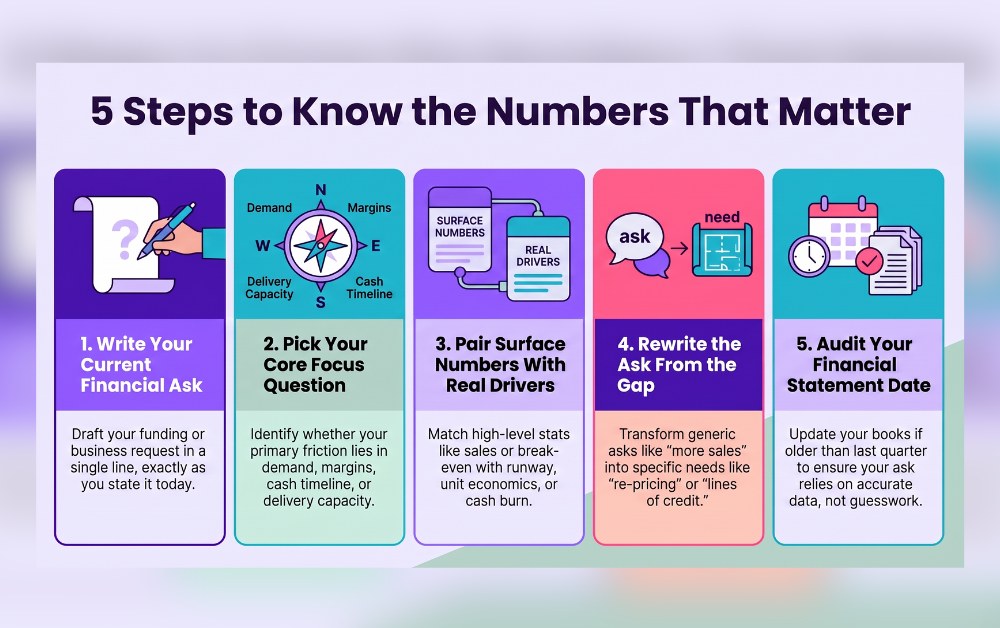
- Write the ask as it stands: one line, the way you would say it today.
- Pick its question: demand, margin, cash or delivery.
- Fill in both numbers: rough is fine. Indicate where you guessed.
- Rewrite the ask from the gap: what would close the distance between the two numbers, and who can provide it?
- Find the date on your last financial statements: that is the whole step. If it is older than last quarter, closing your books comes before any financial ask.
The last one takes five minutes, and it tells you how much of the rest was actually guesswork.
Will the Right Number Get You a Yes?
I wish I could confidently say YES but the truth is: not always. But you still have to try for your business’s sake, don’t you?
A clean application does not open a closed door. In the WEKH and TD survey, a mixed sample in which 35% of respondents were Black or racialized and 24% were immigrants, 45% reported gender-related bias in how their credibility was assessed, and 33% reported loan denials with no clear explanation. I described how to handle that in How Much Should Women Founders Ask For?.
Getting your ask challenged by a trusted advisor is an ask in itself. In my survey, 38% of founders had never shared a critical business decision with anyone. A bookkeeper, a fractional CFO or a founder two steps ahead of you can read the gap faster than you can alone. The women in the WEKH and TD survey said as much: 72% wanted bankers who understand their specific needs and 50% wanted industry-specific financial advice.
What I Put Next to My Number Now
I still start with the number I know. Old habits. What changed is that it no longer travels alone: before an ask leaves my desk, I defined the second number, and detail in one line what the gap between the two costs.
It takes me longer. It also means I am asking for what the business is missing, and not for what I already know how to defend.
So take the next important ask on your list: a loan, a grant, a contract, a sponsor, an introduction. Put its two numbers side by side, then finish this sentence:
The next time I make an important ask, I will no longer ask only for ______. I will ask for ______, because that is what my business needs to reach its next stage.
What goes in your second blank? 💪🏾
TL;DR – What Does “Know Your Numbers” Mean for Women Founders?
- Focusing on the wrong number will have you wrongly confident, misinterpreting critical information for your business, and present yourself as a not-so-knowledgeable founder. Not on purpose, but because you missed what the gap between two numbers means for your business. So you missed what you really should ask for.
- Four questions to ask yourself: is the demand committed, does a sale leave anything behind, what hits your bank account first between expenses and revenues, and who delivers the next order.
- Each question turns a generic ask (more customers, more sales, a grant, more clients) into a specific one (a contract, a repricing, a line of credit or a deposit, an operator).
This is the 7th article in a series on what holds back women founders from visible minority and immigrant backgrounds. The others: (1) What Stalls the Growth of Women Founders?| (2) 4 Frictions to the Growth of Women Founders| (3) The Math is not Mathing for Women Founders in Canada| (4)The Money Gap, or Why Women Founders Struggle to Scale| (5) From Operator to Leader: The Woman Founder’s Evolution | (6) How Much Should Women Founders Ask For? 🤓